Showing posts with label dating. Show all posts

Friday, April 29, 2016

Christians Suck at Consent, Part 2

It gets worse.

Chuck II

The same day all that other stuff happened, another guy messaged me. We'll call him Chuck II, because, again, I don't know anyone named Chuck. Unfortunately for Chuck II, I was on an honesty kick, because of a lack of sleep and what had just transpired with Chuck I.

So when Chuck the Second sidled up to me via facebook messenger and said he was also interested in the project I was working on (translation, "Heyyyyyyyy there"), I told him the truth:

That I felt like he was physically pushy when we dated (we went on two dates total) and that it made me feel disrespected.

His response wasn't great. In fact, it may have filled me with inchoate rage.

Let's go back in time again to a few years ago.

On our first date, we went to coffee. So far, so normal.

At the end of our second date, Chuck II tried to shove his tongue into my mouth after we hugged goodbye. I was taken aback. Again, it felt like it had very little to do with me or with us having a "moment" (I've had moments before. This was not a moment). There were no signals coming from any direction that said, "Now is sexy, sexy make-out time." Was it the bright sunlight of a Hollywood afternoon? The ambiance of the brick walkway in front of my rent-controlled apartment? Who knows.

I pulled away in surprise and soon texted him that I "just wanted to be friends," because apparently things were escalating quickly. He apologized and said he wanted to take things at my pace. I think we settled on something like friends with the potential for more.

The next time we hung out, he was all over me. And when I went to hug him goodbye, he didn't let go of me at first, but instead held me tightly and said, "What if I ask this time?"

And then he pressed me about why I just wanted to be friends as I was about to get into my car to leave.

THIS. This is why.

So when I told Chuck II that I felt like he was physically pushy and he didn't respond well, I got angry.

His response? He wasn't physically pushy—not from his perspective. In fact, he is "hyper-aware of [implied: all] the choices and moves" he makes. Respecting me had been really important to him because he liked me. And I had judged him too quickly.

Not only that—he was hurt that I felt disrespected

Come again? He had violated my personal boundaries—violated my body—but it was his feelings that truly mattered. I had misjudged him. I was wrong, and it was all my fault.

When I said that the conversation was upsetting me and I was ending it, he blithely suggested we meet up for coffee so we could "make amends." And that's when I really lost it.

Again, I felt like a face and a body that a man had projected his wishes and desires onto, not a real person. Hyperaware though he may have been, Chuck II made no mention of being aware of what I was thinking or feeling. I guess he meant, "I was hyperaware that I wanted to kiss you. And so I did."

I felt like a non-entity—Chuck II didn't think he was disrespectful, Chuck II thought he was very respectful. In fact, Chuck II was extraordinarily confident and wildly intentional about all the choices he made during the brief time we dated.

To put it graphically:

Chuck II was more confident about sticking his tongue in my mouth and pressing his boner up against me on a second date than I have ever been about anything in my entire life, ever.

It feels like I'm mocking him (which isn't nice, I know), but I'm actually dead serious: I wish that I had that much confidence about anything—ANYTHING at all—choosing which mismatched socks to wear in the morning, my career, my decision to live in Los Angeles, anything.

With credit to Sarah Hagi for the original version of this
Lack of dating experience or something else? 

It's not like I met these guys on the internet—we met through mutual friends and still have many, many mutual friends. We met in "Safe," "Christian" contexts. They are "nice guys."

It's easy to look at these incidents and think, "Well, maybe he just doesn't have a lot of experience."

I've dated Christian guys like this. They're not always good at dating. They make mistakes. Obviously, not all of them are this bad.

But there's something deeper going on when a guy corners me in his car and almost demands that I give him a chance and go on a date with him (Chuck III?) or when a guy takes my picture after a couple of dates so that he can show his friends a picture of his "girlfriend." Or when a male friend tells me I'm too closed off and judgmental because I don't automatically assume that a stranger who approaches me in parking lot, at night, is safe (because what if he's just a nice guy, standing in front of a girl in the parking lot of Sprouts, asking her for her number, even though all she wanted was to buy some Brown Cow maple yogurt because that sh** is delicious?).

I feel like something is deeply wrong when I'm expected to educate men in their 20s, 30s or even 40s about the fact that women are people too, or when I'm expected to "give a chance" to someone who doesn't even respect me as a real person entitled to make her own decisions.

What doesn't seem to factor into any of these situations is me—my thoughts, my desires, my body, my decisions, my judgment, my intuition.

And I'm tired. I'm tired of feeling like I have to scream "NO" at the top of lungs to get someone to leave me alone. I'm tired of feeling like my pain doesn't have any meaning or significance unless I'm literally bleeding to death or dying of cancer.

I'm tired of being so disconnected from my own body that I only feel the rage of physical violation weeks, months, or years after the fact.

Consent isn't just about sex

Consent is about treating the other person like a person—not a body, not a good-looking accessory, not a blank canvas on which to project fantasies of marriage and children, not a character from a movie—but an actual person.

And these two stories in particular (though kind of funny) have been painful to write about—I've had to sit in it and think about why I felt so violated in the first place.

I've thought about how scary it is for a man to physically grab me out-of-nowhere, against my will, and start tipping me backwards. I've thought about how f***ing scary it is to have someone you don't know very well not let go of you (restrain you) and pressure you for something sexual that you don't want to give. How out-of-control and terrifying it is to feel like in that moment your body is not your own, is out of your control, is in the hands of someone who doesn't even see you.

I don't know how to describe it except to say that it cuts you off from your own physical being. That when you do start to tune back in from the numbness, all you can feel is pain.

It feels like sh**. That's what.


Sunday, October 25, 2015

Three Reasons Christians Make Dating Weird

We had been dating for a few months when he brought up the question of whether we were "boyfriend and girlfriend."

Does this mean we get to hold hands now? [Photo by Brett Sayer]
This was soon followed by, "So should we call my parents? Book a flight back home so you can meet them?"

I was confused—it felt like something we might do if we were engaged, not just officially exclusive.

We had gone on two dates (different guy, because I really get around) when he tried to shove his tongue down my throat when we hugged goodbye.

I was confused—we had seen each other in person exactly three times. Was there some memo about making out on the third meeting that I hadn't received because of a glitch in the Christian worldwide dating protocol server?

Christians. They make dating weird.

It feels like I'm stating the obvious, but dating while Christian can feel like swimming in a pool full of jello, snapping turtles and dynamite—except that getting out with all your extremities is the least of your problems.

From side hugs to guys who won't date you but will let you wash their socks as they pour out their hopes and dreams, Christian dating is just weird.

Why? Here are three reasons:

1. Traditional gender roles

I have heard so many Christian women say some version of either, "No one asks me out" or "I want to be pursued" (including me). Unfortunately, this can extend to every phase of dating—if no one asks you out, then you don't date.

Ever.

Even expressing interest in a guy is suspect—because isn't he supposed to pursue you, as God meant for male/female relationships to play out, from the Garden of Eden on? Adam didn't have to pursue Eve, and look what happened to them.

In this construct, Christian women have to come up with extremely roundabout and sneaky ways to communicate interest in a guy—signals that the guy is somehow supposed to pick up on.

"Would you like to, um, go to Bible study together on Thursday?"
or
"I would love to get your exegetical take on 1 Corinthians 13."

This is all very confusing and great for angsty, 2AM conversations with friends. Not so great for actual dating.

2. Sex

I don't know if I can really explore here all the ways that sex makes Christian dating weird.

There's this idea floating around that if you hold out for marriage, you will have (amazing) sex. No wonder Christians are marriage-obsessed.

Awesome married sex is predicated on how much I save my body for my future husband or wife. If I hold hands with you and we don't get married, does that mean I'm cheating on my future spouse? What if we kiss? Every act of physical intimacy is potentially cheating.

On the flip side, I've encountered guys who grab me and try to kiss me when I've given no indication of interest. At best, it's awkward. At worst, I feel like my boundaries are invisible or irrelevant. The guy has no interest in my comfort level or what I want.

3. Marriage

The threat of marriage hangs over every, "Will you go to coffee with me?", every tentative flirtation, every first, second, 20th date.

Marriage plus gender stereotypes mean that every girl is gunning for a dress, a cake, and a husband in that order and every guy is too scared to actually ask anyone out.

Because marriage is everything, we ask the wrong questions at the wrong time.

At the beginning of a relationship, instead of asking, "Do I like him?", "Do I enjoy her sense of humor?", "Do we have fun together?"—

We ask, "Could I marry her?", "Do we want the same number of kids?", "I wonder what he thinks about living on a farm in New Zealand and raising llamas?", "Do I like her laugh or will it drive me insane after 45+ years?", "OH MY GOD WHAT IF I HAVE TO SPEND THE REST OF MY LIFE CRINGING EVERY TIME WE WATCH THE OFFICE GET ME OUT OF HERE I CAN'T BREATHE."

Ahem.

It's enough to make any sane, commitment-phobic girl bolt.

How do we make Christian dating less weird? I feel like that is fodder for a different post.

More about dating:

Undateable: Why Single Christian Guys Are All Dented Cans - Anger

Monday, October 5, 2015

Undateable: Why Single Christian Guys Are All Dented Cans - Anger

I've written about anger in this series before--in the entry on Entitlement and in the entry on Cowardice. In fact, if I've written about anger in every entry in this series, I wouldn't be surprised in the least.

Photo by Ferran Jordà
This is not about a normal, everyday kind of anger. Anger--the kind of anger I'm talking about--is tightly wound up with entitlement and an underlying sense of victimization:

Victimization: I have been injured.
Entitlement: I have a right to be angry.
Unspoken Assumption: I have the right to enact revenge and/or even the score.

This kind of anger feels dangerous, because it is so deeply rooted in a sense of righteous justification.

Instead of calling it "anger," it might be more accurate to refer to it as bitterness, resentment, or rage--an anger cherished, nurtured, held close.

I'm writing about anger not just because I drew it out of the jar as a writing topic (which I did), but because--

Anger is my Achilles' heel.

If you want something from me, try getting angry. I might just crack.

For whatever reason (maybe getting yelled at as a kid, I dunno), anger has an unpleasant effect on me: My throat tightens. I get quiet. I go numb.

I've learned that anger can be a form of manipulation and control. And it works. I can't think of a single abusive dynamic that I've been a part of that hasn't involved this kind of anger.

One guy I worked with would yell at me, then get even angrier when I responded neutrally instead of emotionally.

He would consistently tell me about how angry yet another guy was with me (triangulation).

This happened again in another situation, where one dude capitalized on the anger of another dude to overcome a break in our relationship (bonus points if it's someone in a position of power, authority, or influence):

"___ is very angry with you. You need to do something. I can help you fix it."

Essentially, Dude A used fear of authority, specifically fear sparked by someone in authority (Dude B) being angry with me, to get what he wanted.

I mean, it worked--maybe a little too well: I soon after entered into an abusive dynamic with Dude B, a dynamic centered around anger, fear and control. It felt a little too much like being handed from one abuser to another.

That was last year. This year, I found myself once again sitting across from one man telling me that another man was "very angry with me." I find this funny (rule of 3; first time tragedy, second time farce). If you find yourself in a conversation where one person is earnestly telling you that another person is angry with you, and what are you going to do about it, I can say with certainty that something is wrong.

But I digress. Achilles' heel.

This is about anger and Christian guys and being undateable.

I had an epiphany once, while working on this series: "Christian men don't actually respect women." And then that thought kept me up all night the way that 3am thoughts sometimes do.

I think there's some truth to it: some men and some Christian men do not see women as equals. They do not see women as fully human. And it's hard to respect someone unless you view them as fully human.

I've heard from a reliable source that "anger is a gateway emotion." If we think about shame as the root of this kind of anger (abusive anger), a disproportionate response to perceived slights* makes a lot of sense:

How would you feel if something not quite a person (that you don't regard as an equal) made you feel completely worthless? Especially when everything you believe about yourself and everything society encourages you to believe tells you that you are superior, the genuine article, the real thing?

It would be incredibly enraging. The balance must be restored. Someone or something must pay. Shame is an unbearable emotion, and it must be displaced onto the body of another.

In this case, violence is just settling the score, evening the debt, restoring the equilibrium.

Where does the shame go?

I've written before about how the burden of shame accrues to women. Even the way we talk about and think about anger contributes to this burden. Anger more than almost any other emotion is seen as "out of control" or "out of my control," serving as a justification for violence.

The less that men are "in control" of their own emotions or passions, the more women are responsible for the outcome of those emotions.

This is not to blame shame for the abusive anger of men--rather, the underlying belief that men are more valuable than women, more human than women, more entitled to respect, dignity, rights, justice, power, autonomy, etc.

Yes, I blame misogyny. I blame Christian teachings that emphasize complementarian gender roles. I believe that a system that enforces rigid, narrowly defined gender roles enables and encourages the abuse of women.

As men displace their shame onto women, they feel better, while women feel worse. Messages from our culture that implicate women in their own victimization serve to reinforce this sense of reverse responsibility: You are the one at fault. You caused your own abuse. You caused your own assault. You were not hyper-vigilant enough.

I suspect that just as men cannot heal the shame of women, women cannot heal the shame of men. And women are definitely not responsible for the underlying misogyny of men's anger.

Another important point: Submission to this type of anger is a bad idea. For so long I bought into a conception of Christian reconciliation that entailed submitting passively to unhealthy and abusive anger. I thought that by demonstrating humility I could heal the relationship and reestablish equilibrium. I even apologized to my very first abuser for treating him poorly (not listening to him, not respecting him). Not even joking.

For one, it doesn't work. It can even intensify the abuse. For another, there is nothing Christian or holy about submitting to dehumanizing behavior. Any theology, church, person who tells you otherwise is selling you an abusive crock of ****.


*I owe this idea to a discussion of Roy Baumeister's writing about abuse at WenatcheeTheHatchet. While I don't agree with Wenatchee's interpretation, I did find Baumeister's ideas about men's rationalizations for domestic violence helpful.

Friday, June 19, 2015

The INTP & Giving Zero Fucks, Part 2

In my first post, I didn't really address how to get an INTP to give more f***s. That will be addressed from two perspectives:

One, you are an INTP and you sense that someone wants you to give more f***s than you are currently giving.

Two, you work with or date or otherwise interact with an INTP and you wish that they would give a f***. This is for you too.

Warning: There may be a definite limit to the number of f***s the INTP can give. Attempts to elicit more f***s will result in system failure. You have been warned.

Okay. So you have an INTP friend, coworker, girlfriend, boyfriend, spouse and they don't seem to care about what you care about. Perhaps she said something and it hurt your feelings. Perhaps he never loads the dishwasher and this is really starting to get on your nerves.

Here's how to get an INTP to give a f***:

Somehow, I don't think this is how it goes down.
Don't take it personally.

If an INTP comes across as rude or uncaring, she may simply be absorbed or hyper-focused. It's not that you don't matter. You DO matter. It's just that right now you matter slightly less than figuring out why the post command on the title PGC is causing the program to crash.

So if her eyes are glazing over as you talk about the latest enhancements in bluetooth technology, it might not be that she doesn't care (well, maybe), but that she hasn't had time to shift her focus from closed, problem-solving mode to receptive, social interaction mode.

You can wait for her to come out of the depths, or you can say something to the effect of, "I really need you right now. Enhancements to bluetooth technology are blowing my mind and I must be heard!" Both of these are perfectly valid options.

Directly confront them if they offended you

Maybe you suspect that the INTP is trying to undercut you, make you look bad in front of other people, prove that she is better than you are, etc. This is doubtful. Subtle power games are very rarely an INTP's forte. She's probably too busy figuring out how to write an algorithm that solves writer's block to specifically target your insecurities.

This is not to completely side with the poor, defenseless, misunderstood INTP. God knows, I have put my foot in my mouth many a time. And I admit that fully, without justification or rationalization.

But better to directly confront what she said or did that offended you, than to assume that she is waging a calculated campaign against your self-esteem.

Don't make it personal.

This one is tricky. The obvious advice is:
  • Don't yell or use emotional language, "You always," "You never," etc..
  • Use "I" statements and focus on the effects of her actions/attitude/words on you.
Don't put her in a position where her only option is to admit that she is a terrible, horrible, rotten, no-good person. You were right, and she was wrong. You're a saint, she's a sinner. You're Batman, she's Ra's al Ghul.

Even if she does give in, this is false submission, and she will resent you for it.

The less obvious advice: Take out your own trash.

Everyone has insecurities and painful emotions that they deal with, sometimes every single day, sometimes every single moment of every single day. As much as you can, try to make it a priority to take out your own trash--this means not projecting your own insecurity onto someone else's indifference. This means dealing with your pain as much as possible. This means being angry, but not taking it out on someone who doesn't have the power to fight back.

It's much easier said than done.

Maybe the zero-f***-giving of the INTP is opening up a space for you--the space between your expectations and reality. Maybe this is a gift. Maybe this is a space in which you can confront not the INTP, not the "bad attitude" or indifference of another person, but yourself.

Maybe.

Never back them into a corner.

I mean, seriously. Don't back anyone into a corner. Don't threaten her job or his entire relationship with you. Not unless you want them to leave/quit/break up with you. If you do, then go for it.

Examples of backing someone into a corner:

"If you really loved me, you would empty the dishwasher!"
"You didn't send me this progress report on time, so clearly, you don't give a f*** about this job."
"I must be a terrible friend, because you refuse to watch "Scandal" with me."

Deliberately ask them to shift their focus

Shifting from one priority to another can take a lot of effort for anyone. Sample script:

"I know I asked you to spend time working on X, but Y just came up, and it needs a lot of work. Would you focus on Y instead, for the time being?"

"I know I mentioned that it's very important to me that you always load the dishwasher a certain way. I realized that what I really wanted was for you to load the dishwasher at least every other day. Would you mind doing that?"

If you are in a friendship or relationship with an INTP (or anyone else), it is perfectly okay to specifically request what you need.

As I mentioned, it is a good idea to be both specific, and deliberate. Spell it out if you have to.

The INTP does give a f*** about you, or they wouldn't be in the relationship in the first place.

You can't change how someone feels

Often, it is not that the INTP does not give a f***--they very much do. It's that she does not give a f*** about what you want her to give a f*** about.

This could all be based on miscommunication, i.e. she doesn't know that something is really important to you or that it bothers you.

It could also be based on domination and power struggle: You think that by "making" the INTP give a f*** (possibly by making them suffer or pay a price), you are asserting your authority as the boss, parent, professor, pastor.

I would tread carefully here: It is possible to control someone else's actions in a certain sphere if you are in a position of power. It is nigh impossible to control how someone feels, without resorting to abusive or coercive tactics.

Power struggles over things like "respect" are suspect to me--you can never force someone to respect you, you can only force them to pretend as if they do. This just seems unhealthy all around.

In Part 3, I'll talk about how an INTP can give more f***s if they so wish.

Relationship advice for the INTP
INTP = Asshole?
The INTP and the Missing "Nice"

Tuesday, June 16, 2015

Undateable: Why Single Christian Guys are All Dented Cans: Entitlement

I went back to the beginning recently, and read about the misogynist, the coward, the racist, and the guy who won't take "No" for an answer.

And I found it striking. Partially because a few things have happened:

1. I stopped going to church.
2. I'm not sure I want to date Christian guys anymore.
3. I encountered more than one man who is a husband, father and believer in Jesus Christ, and also spouts Red Pill Reddit language and rhetoric.

This last one, if I'm honest, leaves me feeling heartbroken and confused--I feel betrayed, somehow.

And that sort of leads me to today's topic, entitlement.

"Entitlement" feels like a hot button word that gets thrown around a lot, particularly in articles about Millenials and the job market. But what does "entitlement" mean in the context that I am writing about?

I turned to Google to find out what exactly people feel entitled to. The results were predictable and a bit dull--the short version is that people feel entitled to government benefits, such as:

Entitlement to medicare
Entitlement to social security
Entitlement to paternity leave
Entitlement to bank holidays

And the puzzling:

Entitlement to kill a mockingbird

My two favorite things to be entitled to:

Entitlement to wear kilt
Entitlement to tea breaks
Photo by George Redgrave

Sam Heughan in "Outlander" on Starz
Yes. One thousand and one times yes.

[Why has no one made a calendar of attractive, possibly shirtless men in kilts drinking tea? I would buy the hell out of that calendar.]

So here's my unofficial definition of entitlement:

Entitlement is an unwritten, unquestioned and often unconscious law held to be inviolable and true, so that when the law is broken, the entitled person is justifiably angry, hurt, and vengeance-seeking.

[And its converse: Entitlement is an unwritten, unquestioned and often unconscious law held to be inviolable and true, so that when the law is upheld or enforced, the "victim" of the entitled person cannot justifiably be angry, hurt, or vengeance-seeking.]

I feel like entitlement, taking the posture and role of the victim, and not taking "No" for an answer are all tangled up together.

You learn the unspoken rules of a relationship, sometimes when it is in the process of ending, often after it has already ended. In one of my relationships, the unspoken rule was: You are not allowed to leave.

Entitlement is the unspoken law that leads to violence.

You see, I don't think anger, or the pain at the heart of anger, causes violence. There's another step there, another component--

The man doesn't kick the dog because the boss yelled at him. The man kicks the dog because he believes he has the right.

Let me give a simple, everyday example:

The law: A woman must always graciously and without rancor accept a compliment from a man. [Especially if he is a stranger]

It's funny, really. It's violence wrapped up in "You're beautiful." And what's even funnier is that the violation of this law is already presumed, the compliment followed immediately with, "I can give you a compliment" or "That's a compliment you know," before the woman even has time to react--the hatred trailing so closely on the heels of love.

And it's not just strangers.

I've thought a lot about the disparate rage that men have directed at me--from the first emotionally abusive relationship I had in my early 20s, to more recent experiences. I think about a story that a friend once told me.

He was a friend of the family. And he had a crush on her, despite an age difference of some 20 years (she was in college, he was in his 40s or 50s). He was giving her a ride, but she had brought a friend along--probably for safety.

And for whatever reason, he was angry with her. Angry because she brought a friend. Angry because this wasn't going according to plan. Angry because she didn't reciprocate his feelings. Angry.

And he threw acorns at her.

In the scene I imagine, there is nothing playful about it. He is looking down, not making eye contact. Scuffing his shoes against the dirt. Casually picking up an acorn. Half-heartedly throwing it. The petulant anger of a 10 year-old in the body of a middle-aged man.

There's another guy that I know. And he's one of the good ones. But I was recently struck anew by the memory of something he once said about my writing. I was struck by how passive-aggressive it was, this single comment. Rage, buried deep.

I laughed it off, initially. "He's just intimidated," I thought.

It's always just some guy. Throwing acorns.

I have no desire to date an acorn-thrower. But if even the good guys are like that--I don't know. It breaks something open inside of me.

I wonder if entitlement is at the heart of misogyny--these unspoken laws:

"You don't respect me": You must respect me
"You don't give a s*** about my intentions": You must give me the benefit of the doubt at all times, and forever.

It's not anger. Because anger doesn't cause abuse. It's not pain. Because there are many, many men (and women) who experience intense, searing, heart-rending pain and yet fail to abuse anyone.

It's not that they rage--it's that they feel justified in their cruelty.

I'm trying to avoid dating abusive guys.

Wednesday, April 29, 2015

Should I Stay Or Should I Go?: Knowing when to quit a job, relationship or kickball team

Ever have a job you hated from the first minute of the first day? What about a boyfriend who made you feel small and alone after two weeks of dating? Rarely do jobs or relationships start out as toxic or abusive. If they did, we would leave right away.

So how do you know when to quit? What might happen if you stay?

Dr. Henry Cloud makes the distinction between "pain with a purpose" and "pain for no good reason."

Pain means something is wrong. My friend and fellow blogger goes into detail about that here, and I also wrote a post about pain here.

Bottom line: Pain Bad. Also, there are different kinds of pain, and it can be useful to define which kind of pain you are currently experiencing. Is it getting better? Is getting worse? Are you feeling numb to the pain? How does the person/atmosphere/task make you feel on a regular basis?

There are some kinds of pain that are inescapable--akin to being stuck on the 405 at 5pm on a Thursday. If you can avoid it, by all means do so. If you can't--that's life.

But there are other kinds of pain that are simply not worth it.

I read somewhere that there is a name for pointless suffering: torture.

Sometimes we buy into the idea that it's supposed to be hard--marriage isn't easy. Learning to play the violin or make the perfect pie crust might require long, tedious hours of practice. But there are some kinds of pain that are not in the service of a greater good. There are some kinds of pain that only break you down over time.

So, is this suffering (assuming it's not inescapable) making you a better or a worse version of yourself? Are you suffering for no good reason?

It's also good to process how you are coping with the pain. Are you using healthy or unhealthy coping strategies?

For example, disassociation from your environment, from people, from a hostile relationship can be an extremely useful coping strategy--however, rarely is cutting yourself off from your emotions a good long-term strategy.

Even if you are not working in an abusive or toxic environment, emotions like frustration, boredom, and dissatisfaction are worth paying attention to. Maybe they don't mean you should immediately quit your job--but they do mean something. Like maybe now is good time to move on, if you're able.

As for work situations and relationships that are abusive, the first step is recognizing the cycle of abuse. Here's an example from a work situation:


"Cycle of Abuse" by Avanduyn -  Licensed under Public Domain via Wikimedia Commons - http://commons.wikimedia.org/wiki/File:Cycle_of_Abuse.png#/media/File:Cycle_of_Abuse.png
1 - Tensions building: As the deadline closes in for a project at work, I start to feel a sense of dread. Although I am doing all I can, I still fear that my boss will be displeased with the final product, no matter what I do or don't do. I have seen him explode in the past, usually the night before the project is due. He has also made threats about what might happen if there is a repeat of past "failures." I feel like something terrible yet undefinable is about to happen.

2 - Incident: The night before the project is due, as predicted, my boss explodes at me in a company meeting in front of our entire team for "Not presenting it in the right way." I feel helpless and unable to defend myself. I feel worthless and doubt my ability to ever get it right. The entire room is thick with tension, anxiety and fear. Everyone else looks completely cowed and no one stands up for me. My boss justifies his belittlement as necessary because other tactics (praising me, telling me I'm doing a good job) have not worked.

3 - Reconciliation: My boss is absent for much of the rest of the week. When I see him again, he appears to be in a better mood, and no mention is made of the meeting.

4 - Calm: My boss tells me he is just trying to help me develop in my career. He seems to want to work more collaboratively and tells me that I have a lot of potential.

A note here about anger and distinguishing between normal, reactive anger and anger that is abusive:

I think there is a difference. As far as I can tell, abusive anger (unlike normal anger) tends to fill the room. It has layers of hurt, shame and blame that go far beyond the context or situation at hand--imagine that you and this person are in a relationship and you cheated on them and ran over their dog on purpose--that's what it feels like. The goal of abusive anger is to hurt, control and punish the other person.

If you are in an abusive situation, I would recommend getting out now. Instead of thinking about what could be--he could be the man of your dreams, this could be the job that catapults you to success, it could get better, there could be an opportunity here to do something you love--think about what is.

Think about what might happen if instead of getting better, things actually get worse--whether it's your partner's anger or an abusive cycle at work. Abuse tends to escalate gradually over time, so that boundaries that you never thought would be crossed are suddenly fair game. When you are in a toxic or abusive dynamic, it can be impossible to see the situation objectively--even more so if the relationship or job constantly puts you in fight or flight.

Here are some not-so-great reasons for staying in a bad situation:

1. You keep thinking about the good 'ol days when you first started the job/relationship.
2. There's a small chance conditions will improve.
3. He/she can change. You believe in them!
4. You're afraid that no one else will ever love you or hire you again.
5.You want to prove "them" wrong.
6. You are seeking justice for wrongs done to you.
7. You are waiting for permission to leave.
8. You think that the pain is making you "better."

I once overstayed a bad job situation by roughly three months--three of the worst months of my life, not to put too fine a point on it.

I kept thinking that when I finally left, things would start getting better. What I didn't expect was that, instead of getting better, things just stopped getting worse.

I feel like this is an important distinction. Are things getting worse? Is the abuse escalating? Are you continuing to put yourself in a situation that you know is harming you emotionally, physically, mentally? Get out. Stop waiting for them to get better. Stop waiting for him to change. Stop waiting for people to listen to your side of the story. Get out get out get out.

You are more important than any job or relationship.

If you do choose to leave an abusive relationship of any kind, take steps to protect yourself from retaliation by making sure that person has no access to you (preferably), zero leverage over you, or if that's not possible, that you have a support system and a safe place to go.

I'm rooting for you.

Tuesday, April 14, 2015

Undateable: Why Single Christian Guys are All Dented Cans - The Myth of Persistence

Photo by quinn.anya

So I've started doing this thing where I'm completely honest with men. Why?

Well, for one, it amuses me and my dark sense of humor. I get to say fun things like:

"I'm not interested in pursuing anything romantic with you."
"Hitting on one person on the fb status of another person is kind of a douche move."
"You fondled my earring at a BBQ and it made feel uncomfortable and disrespected."
"When you grabbed me from behind around my ribs directly under my breasts [yeah, that happened], I felt unsafe and violated."

Yep. That's right. Just waiting for the marriage proposals to roll on in.

For another, I'm done protecting a man's feelings at the expense of my own personal safety.

And that brings me to the topic for today in dented cans: THE MYTH OF PERSISTENCE. And yes, it definitely deserves to be in all caps.

There's this weirdly longstanding myth out there that women want men who will continue to pursue them even in the face of blatant rejection (see also, "The Notebook").

You say, "I just want to be friends."
He hears, "I just want to be friends until I change my mind and decide we should definitely get married and have five kids."

You say, "I'm not interested in you in that way."
He hears, "I'm not interested in you in that way, but you should definitely grab me and try to kiss me."

You say, "I like someone else."
He hears, "He's probably a douche-bag--so you still have a shot!"

To the men that believe this myth, "No, I'm not interested" means "Try harder. You're not trying hard enough. Persist long enough and I will say 'Yes.'"

Except it doesn't mean that.

No--when you persist in pursuing me after I have made my feelings clear, I can only assume that there is something wrong with you either emotionally or mentally. And the last thing in the world that I desire is to have an emotionally or mentally unstable man pursuing me, or worse, believing that I owe him something--a date, friendship, my time, a second chance.

In short, when a man will not take "No" for an answer, all my self-preservation instincts kick in, and all I want is for him to stay the **** away from me.

I feel fear and anger.

Fear--because if this man apparently can't understand or chooses not to understand the words that I use to communicate (perhaps if I did an interpretive dance?), who's to say what other boundaries of mine he won't violate due to this "misunderstanding"? If he has already violated my verbal boundaries and made me feel unsafe, there are still other boundaries he has yet to cross: emotional, spiritual, mental, physical.

But truthfully, I have trouble understanding the level of pure terror I feel when a man refuses to take "No" for an answer.

My best guess is that this is a dehumanizing experience--I am not a person to these men. I am the projection of all of their baggage about women. I "owe" him something--my body, my "Yes," a chance for him to prove that he is the man of my dreams and we are meant to be together-- In short, I cannot give consent because I am not fully human. His pursuit has very little do with me, and so much to do with the fantasy world he has created in his mind: A world in which I should say, "Yes."

At a certain point this fantasy becomes far more important than my humanity. And that is terrifying (cue visions of being chained up in a dungeon somewhere by a man who "just wants to love me," and is willing to wait as long as it takes for me to realize that).

My guess is that many men fail to understand this as well--they have never experienced fear for their personal safety in the context of romantic relationships, partially because women are not encouraged to pursue in the face of rejection, in fact, quite the opposite. Any romantic rejection is humiliating and shameful.

And what about "Not Leading Him On," that crime that women seem to be accused of at a substantially higher rate than men? Why do women so often take the path of least resistance, trying to "let him down easy." It goes back to fear, again. Women have been taught that saying "No" is not only rude, but also dangerous.

A stranger came up to me in the 99 cent store and told me that I was "beautiful." He followed this up immediately with, "That's a compliment you know."

Of course, I enjoy compliments most when they are followed by vaguely hostile or threatening statements. I also enjoy being put in a situation in a public space where I am expected to thank a stranger for harassing me or be subjected to the accusation of "ungrateful b___ who can't take a compliment."

Unfortunately for me, as a woman, I fear for my physical safety. Therefore, I try not to engage with men in an aggressive or potentially escalating manner.

The same goes for turning down men who are romantically interested in me--but as it turns out, it matters very little what I say:

I've had different Christian guys: Corner me in a car and demand repeatedly that I go out on a date with him, then text me to apologize and tell me that he really "respects" me; Tell me my job is on the line unless I let him back into my life (as a friend, of course); Ignore my request to be "just friends" by grabbing me and dipping me for a kiss, all while citing the scene in "Hitch" when Will Smith and Kevin James accidentally make out ("You lean in half way, then wait for her to go the other half").

Then there's the anger--yeah, being seen as not quite human kind of pisses me off. And there's the icky, would rather not think about it, idea that my biracial, "exotic" looks only contribute to the extent to which men are able to project their own fantasies onto my very real, non-white (but still human!) body.

The intersection between race and perceived sexual availability is a fraught one at best--but whether it applies here or not, let me just say:

I don't want to be touched, grabbed, or groped in public by men I don't know.
If I say I don't want to date you, I mean exactly that, and I don't care to repeat myself.
I am in no way obligated to explain to you why I am not interested. I owe you no justification whatsoever.
If you won't take "No" for answer, consider yourself banned from my life.

So why is it that Christian men are so horrible at grasping the concept of women as fully human?

The word "consent" is quite the buzzword these days, but I believe there are many Christian men who do not grasp the concept:

Consent (or if you prefer, "Respect") isn't just about sex. It's about respecting the boundaries of another human being--seeing them as fully human--in every single interaction, romantic or not.

There are certain things that "Nice" Christian guys tend to believe or say that are inconsistent with consent:

One, believing that if you go to the trouble of asking a girl out, she should say, "Yes," just because you took a risk and put yourself out there.

Two, if you ask a girl out and she says, "Yes" even though she is not ultimately interested, then she is leading you on.

Three, you are a "Good Christian Man" but every girl you ask out says, "No," meaning that there is something wrong with them, not you. You are a victim of feminism, shallow female whims, or unfair discrimination.

Four, if a girl says "No" before the first date or after five dates, you deserve a full, complete, and honest explanation as to why.

Five, women don't actually know what they want. They read romance novels and "Fifty Shades of Grey" and then complain that they don't want to be raped, beaten, sexually harassed, or coerced into sex. What gives?

One and two are obviously contradictory, but I have heard both. Trying to control whether or not someone says "Yes" or "No" to a date is contrary to the idea of consent--and trying to control a person's motivations in general feels fishy.

For three and four, being rejected sucks, obviously. But believing that someone else is "wrong" for rejecting you or that the the entire female population is delusional because they are not romantically interested in you is also contrary to the idea of consent--particularly to the idea that a woman should be able to choose to date or not date someone for any reason. Yes, any reason, even one you think is shallow or stupid.

Also contrary to consent is manipulating a person into unwanted contact of any kind.

For five--well, perhaps that is the subject of another blog post, but it boggles the mind that women are still not allowed to be complex or contradictory beings with a freedom of choice and personal autonomy that transcends one particular sexual fantasy or choice of reading material. "Women don't know what they want" seems highly correlated with the myth of persistence--"Women don't know what they want" but "I (a man) know what they should want." Gross.

In conclusion, if a guy will not take "No" for an answer he is, in my opinion, undateable.

Up next in the Dented Cans series, a post on entitlement.


Thursday, April 9, 2015

Undateable: Why Single Christian Guys Are All Dented Cans - The Racist

Coming never to a store near you

[Catch up on the premise of this series here.]

I know you've all been waiting with bated breath for this next installment--

And on the docket today for cringey subject matter, racism.

It probably won't shock you to know that, like misogyny, racism is a deal-breaker for me in a dating relationship. This hardly feels like ground breaking territory.

After all, how many of us look at a prospective dating partner and think, "You know what would be really awesome? If he/she were just a little bit racist every once in while, just to keep me on my toes as an ethnic minority."

No. Highly doubtful.

But despite that generally accepted reality, I dated a racist Christian guy.

This is embarrassing and shameful for me to admit. How could that even happen? I'm a college-educated, biracial feminist who studied English literature. I've read Spivak and Bhabha for crying out loud. That **** takes commitment (and roughly four cups of coffee or 20 cups of tea, depending on whether you're stateside or across the pond).

Here's my theory: we tend to work with a simplified framework of reality when it comes to other people.

So in my non-hypothetical case, I have a framework in my mind about Jack's character. I think of him as highly sensitive and extremely compassionate based on the sum of all my interactions with him (the mathematical function of our relationship).

So when Jack says something that doesn't fit within the framework--"Sensitive to other people's feelings," "Compassionate," my mind places these utterances outside of the established framework as rare exceptions.

The same holds true with racist comments. Far from pouncing on a statement with a gleeful, "Aha! I knew it! All white people harbor secret racist thoughts," my mind seeks to integrate the new information into previously held conceptions about Jack's basic character.

There's no way someone this empathetic could be racist. Right?
I must have misunderstood what he said. I think he meant something different.
But he's a Christian.

To return to the subject of this post, whether or not someone is a Christian seems to be only a very mild marker of whether or not he/she is also racist (completely debatable of course).

Observationally, however, a shared belief system like Christianity can function much like a shared disgust for the Other, whatever or whomever that Other might be.

"We're Christians so of course we think ____ is disgusting/sinful/wrong."

More observational thoughts about the intersection between being a Christian dude and being racist.:

The "Other" and Disgust

When I've heard Christian guys that I dated (or didn't) say something racist or bigoted or prejudiced, I couldn't help but register the tone of disgust.

Isn't that what racism is, in a way? Gut-level disgust about this inferior group of people? Whether they're destroying America, rioting in the streets about injustice, or brutally asserting their worth as human beings, nothing done by "people like us" ever seems to elicit an even remotely similar reaction.

Even if it's not aimed at you, you feel it like a punch in the stomach.

I want to make a quick note here about the possible connection between racist remarks and having a personality disorder. I mention this later on, but I hypothesize that there is a potential connection--and I want to point it out as a red flag: The person you are dating might not only be slightly racist, but also emotionally dangerous.

The "Other" and Forced Teaming

Gavin de Becker talks about forced teaming in his great book "The Gift of Fear." Basically, the predator uses the tone and language of "we're in this together" to establish rapport and trust with his victim. Example: a stranger points out that you're both unprepared for the rain, commiserates with you about your lack of an umbrella, and then offers to give you a ride in his car. [STRANGER DANGER]

Racist remarks can function in much the same way. A conspiratorial lowering of the voice (ooh, I'm being so daring and countercultural right now, I can't even). The message:

We're in this together.
We both feel the same way about this controversial issue.
We're superior and better than those other people.
You agree with me by default, because you're clearly not part of an inferior racial minority.

My silent response making me a co-conspirator, implicating me in the same kinds of beliefs--to challenge them would be to lose the relationship. I betrayed myself. And I hate myself for it.

I reached a turning point in dealing with this particular relationship when I realized that the racist (and sexist) remarks were far from the exception to the rule--they were beyond calculated and intentional. Far from being the isolated pinpricks in a compassionate, honest and loving relationship, they were the deliberate wounds of an abuser.

He discovered my deepest vulnerabilities. And wielded that knowledge like a weapon to hurt, manipulate and control me.

The "Other" and Political Correctness

Something odd tends to happen if you even hint to a man that he might be racist or sexist.

He begins clutching his pearls (haha), crying, "No! Not me! I would never believe such things. What kind of sick, twisted monster do you think I am?"

Because apparently, calling someone a racist is stopping just short of calling them a child molester.

Well, let me be neither the first nor the last to say:

"He doth protest too much."

Often, after letting you know that you've offended his delicate, white male sensibilities, he follows with, "Well, I'm not politically correct if that's what you mean."

I have a theory about not being politically correct:

Speaking the language of politically incorrect is a way for those without any real power to puff themselves up--like the so-called "alpha male" who is secretly insecure and terrified of his own weakness.

Why are Christian men politically incorrect?

1. They feel personally disempowered in their lives and adopt what they perceive to be the vocabulary of power (politically incorrect speech) as a posture of "I can say whatever I want whenever I want, but only around people who are like me and agree with me and only about people who are less powerful than I am and unlikely to fight back." See also, cowardice.

2. Christian dudes refrain from challenging other Christian dudes in Christian Bro-centric environments.

Being politically incorrect is putting on a brave face for the lads--what with all the oppressive powers of feminism making it impossible to be a "real man," because God knows, merely having a penis is just about enough to get you locked up these days.

Church & Patriarchy

Speaking of power, perhaps the church tends to attract men who feel disempowered in other areas of life. The church, unlike other contexts, tends to place a premium on male leadership--even more progressive churches do this. So a man who is not a leader in any other part of his life might find himself an integral part of church leadership.

Of course this is speculative, but I would observationally argue that men who attend church might feel a greater sense of being victimized and disempowered in other parts of their lives, and so seek out greater involvement at a church that values them and their contributions. They might lack power politically, socially (be socially awkward, for example), economically (unemployed or underemployed), or romantically (perceive themselves as the "nice guy" that women always reject).

Just to reiterate: We are all dented cans. Male or female. White, Black, Asian or Hispanic. However, the sense of victimization that seems to come from the gap between being apparently privileged--you're white and male! Go you!--and the reality of working at Coffee Bean, relying on your parents for gas money, and asking women out only to be repeatedly rejected--feels somewhat specific to the demographic I am writing about.

Again speculatively, in this day and age for white men, I'm not sure if racism or politically incorrect language can be entirely separated from a personal sense of victimization.

Note: Playing the victim is a common sociopathic trope.

Clearly I am not saying that all men who say racist things are sociopathic (just the guy I dated).

But, I think that this sense of victimization dulls a person's empathy to any and all who are perceived as Other. After all, if you gain part of your sense of self from being a victim of society, why the hell would you want to share that power with someone else?

And what defines a sociopath? Lack of empathy. And that's not the kind of guy that I want to date.

So to conclude an overlong post: Racism bad. Racist guy bad. Racist Christian guy--the worst.

Have a great day.

Up next in the series, men who won't take "No" for an answer, or The Myth of Persistence.


Friday, January 2, 2015

Undateable: Why Single Christian Guys Are All Dented Cans - The Coward

Aristotle on bravery in "Nicomachean Ethics," from a translation by Terence Irwin

Welcome to my series on dented cans AKA single Christian guys who are undateable (to me!). 

After tackling the fluffy, soft as a guinea pig's butt cheeks topic of misogyny, we are now moving onto a much less potentially inflammatory topic: cowardice. 

[I swear, I am literally drawing these topics out of a jar. Swear to Blog.]

Now, you may see "coward" and "cowardice" and think, "I know where she's going with this!" And I bet you two pounds of canned beets that you're wrong (I hate beets. Hate 'em). 

You see, I too am familiar with the diatribes, written and otherwise, urging Christian dudes to just step up to the complementarian gender roles plate and ask a girl out already. I mean c'mon! How hard can it be? Think of all those lovely, eligible, extremely single Christian girls who are not too busy writing wistful letters to their future husbands to say "Yes" to dinner and a PG movie with you (and who if you play your cards right, might even agree to marry you after the third date!).  

This is not that blog. If you want to read (or hear) about how Christian men should stop being such [women?] already and just ask a girl out, you can go here, here, or here. And good dating to you, sir or madam.

The truth is, I'm as ambivalent about this topic as a single Christian woman could possibly be. I feel like the "Be a man and ask her out" and "Be a woman and wait for him to make the first move" setup smells awfully like the traditional gender roles that have traditionally kept women in a one-down position of power in adult relationships (such as those between a boyfriend and girlfriend or husband and wife). 

Just speaking personally, if my church wants to reinforce these gender roles--you know, the ones where men get the final say on all decisions, men lead and women follow, men love and women submit, etc.--then I also want a "real man" who will carry me 20 miles in 5 feet of snow so that I don't get my dainty feet wet, who will bring home the bison while I sit at home sipping tea and refining my embroidery skills, and who has the physique of Chris Hemsworth and goes shirtless at all times. Just saying. 

So, no. This is not a blog about how Christian guys are cowards for not asking girls out. I really can't speak for any one guy's motivation for not asking any one girl out. The closest I can get is that he doesn't want to. The whys beyond that are beyond me and my personal scope of knowledge. However, if someone wanted to write a blog about this, I would support him or her at least 101%. 

And now to get back to my subject: Cowardice. Merriam Webster unhelpfully defines cowardice as "the absence of courage." I have a different definition, which I will expound here, at length (you lucky readers, you).

I define cowardice as deliberately hurting, humiliating, abusing, harming, putting down, or bullying someone from a position of power, privilege, or advantage (usually because you can and because it makes you feel good, (read, more powerful)). 

A story: 

I was working in a small business packing and shipping books for a living. I had long thought that the office manager had a crush on me (it wasn't reciprocal). 

So one day we were particularly busy, everyone was present, and I was packing and shipping the heck out of some books. The OM became irate and started yelling at me for overpacking the boxes. 

He took out some of the books that I had already packed and threw them (well, maybe he placed them) on my desk. 

He yelled at me in front of everyone: in front of my boss (his boss too) and in front of my coworkers. 

I was so angry. I confronted him the next day and told him I was not okay with what he did. He admitted to "being a huge jerk" and said he had actually been angry at another coworker who was not me.

This incident has always stuck with me for some reason. I think it's because when I thought back to the power dynamics of the situation, there was no one else in the room who would have been safe to yell at. He couldn't yell at our boss. He couldn't yell at my married female coworker or either of my male coworkers. 

I was it. 

The only way I can explain it is that liking me gave him some kind of carte blanche to vent his anger on me--

Or perhaps I was just the least powerful person in that room. 

I wish I could say that this was an isolated incident. That I've never before or since had a male boss/coworker/supervisor with romantic interest in me treat me with disrespect and anger because I rejected him. That I've never again had a man humiliate me, abuse me, condescend to me, or shame me under the guise of "just doing his job." 

I wish I could say I have never felt trapped in a job in which a man repeatedly violated my boundaries and made me feel profoundly unsafe. 

You see--here's what I don't get about abuse in our current culture: 

All the shame accrues to the victim: "Why didn't she leave him when he hit her?", "Why didn't you walk away?", "What were you thinking dating him in the first place?"

Why are we neglecting to call out the abusers and the bullies for the cowards that they are? I see nothing as more cowardly than punching out a woman who is half your size or using your position of power as a white, male, conservative blogger to further shame rape victims into silence (I'm looking at you, Matt Walsh). 

I fail to understand why Ray Rice dares to show his face in public while Janay Rice fields questions about why she stayed.

Somehow the definition of "being a man" still includes dominating women and treating them as objects to be controlled. Slap her around and you're a "man," not a coward.

After the incident above, I left that job soon after. I was afraid. I didn't want to become OM's emotional punching bag merely because he had a romantic interest in me. I felt like the most likely target, and I had no way to predict that there would be no future incidents--what if he had a really bad day? What if the mice ate all the books or I packed books into boxes in a way that just didn't suit him or the sound of me hitting the "s" key repeatedly started jangling his nerves? These things are impossible to predict. 

This is what I'm having trouble wrapping my head around. That abusers abuse because they can, because they want to, and because it makes them feel good.

He yelled at me because he could.

[Little to no risk to himself: If he yelled at the boss, he would risk getting fired. If he yelled at a male coworker, he might risk getting punched.]

He yelled at me because he wanted to.

[Anger feels bad.]

He yelled at me because it made him feel better.

[Letting anger out feels good.]

In the nearer past, a man viciously attacked and shamed me at work. I'm still traumatized by what happened. 

But here's the thing: 

He used what power he had to punish me, to put me down, to degrade me and "put me in my place" and it made him feel good. If not that, I'm sure it made him feel better--more empowered, more in control.

I also knew, based on past experience (I'd been to this rodeo before), that this was part of a pattern of abuse: His actions signaled to me that this could and probably would happen again: anytime he felt disempowered, received a nasty letter from the IRS, or felt angry about something else going on in his life--

It wouldn't matter. How I did my job wouldn't matter. What I said or did wouldn't matter. If he wanted to take out his anger out on me, he would find a reason.

Imagine that being your everyday, working reality: stretches of rainbows! and sunshine! punctuated only by abuse for no other reason than he "felt like it."

A coward will not confront his boss about injustice or mistreatment, but he will take it out on someone weaker than he is. In fact, he feels justified in doing so and often feels like a victim himself.

That's the problem with cowards. They are too smart to attack someone who has more power than they do, because they know they will suffer the consequences. They don't even much care for engaging an equal. But someone who is "weaker"? Perfect. 

For whatever reason, cowardly men also seem to feel perfectly justified taking out their anger on women who have romantically rejected them. Often, they take on the mantle of "victim" (of society, women, the government, their boss) to justify their behavior and deny their own power and culpability:

"I wouldn't be such an asshole if a woman hadn't broken my heart."
"I was a nice guy until I got rejected for the 20th time."

So, that leads to the question, how do you deal with a coward? 

Directly. To his face. Tell him in no uncertain terms that his behavior is unacceptable.

There's a great book called Verbal Judo about conflict and communication. In it, he talks about three kinds of people: nice people, difficult people, and wimps. You can guess who the cowards are. He recommends calling wimps out in public or confronting them in private (not recommended unless you are in a position of authority). 

Faced with real power, a coward will back down 100% of the time. It's that cliche you see in movies: the underdog can't take it anymore and fights back, leaving the bully a blubbering mess. 

There's some truth to that.  

This is not about playing nice, conflict resolution between equals, or fighting fair. Cowards never fight fair, so watch your back and enlist the help of an older brother or sister if necessary. Here are some possible responses:

"I will not tolerate being spoken to like that."
"Stop it."
"Back off."

Make yourself look as big and threatening as possible. Pretend you're at Yosemite and he is a brown bear. Show that you will not be intimidated and he will scuttle away with his tail between his legs.

Remember, he is not looking for an equal fight. He only abuses those he perceives to be weaker or more vulnerable than he is and will probably be shocked if you actually fight back.

Or you could just punch him in the face (I take no legal responsibility if you decide to take this route but I'll probably be cheering for you from the sidelines).

I jest. But in all seriousness, watch out for the coward. I had a lot of difficulty processing what happened to me until I started looking at it from the lens of power. To you, it might be a conflict between equals, but to him, it's all about making you feel small by any means available (shame, condescension, repeating negative things other people have said about you, attacking your character and personality, blaming you for everything, etc.). You become an object of uncontrolled hatred and rage.

The crux of what makes Christian guys undateable is that their actions often indicate that they don't view women as human beings worthy of equal respect.

Cowards don't respond to rejection very well (how would you feel if some inferior object rejected you?). And neither do some Christian guys. More on that later.

The glass jar has yet to speak on what I'll be writing about next. Till then.

Next: The Myth of Persistence

Monday, December 15, 2014

Undateable: Why Single Christian Guys Are All Dented Cans - The Misogynist


[For an introduction to this series, go here.]

There's nothing subtle about misogyny. The word literally means, "the hatred of women."

To me, if a guy is a misogynist, it makes him undateable. Harsh, I know. But a girl's gotta have her standards. If a man hates women and wants to date me, I consider it a conflict of interest. Because I am a woman. Sorry. It's not something that I chose. You could say it chose me.

Recently, I checked out this book from the library and had it sitting relatively inconspicuously in my apartment. Three different women came over in one evening, each arriving at a different time. All three immediately noticed the book and had a strong reaction to it:

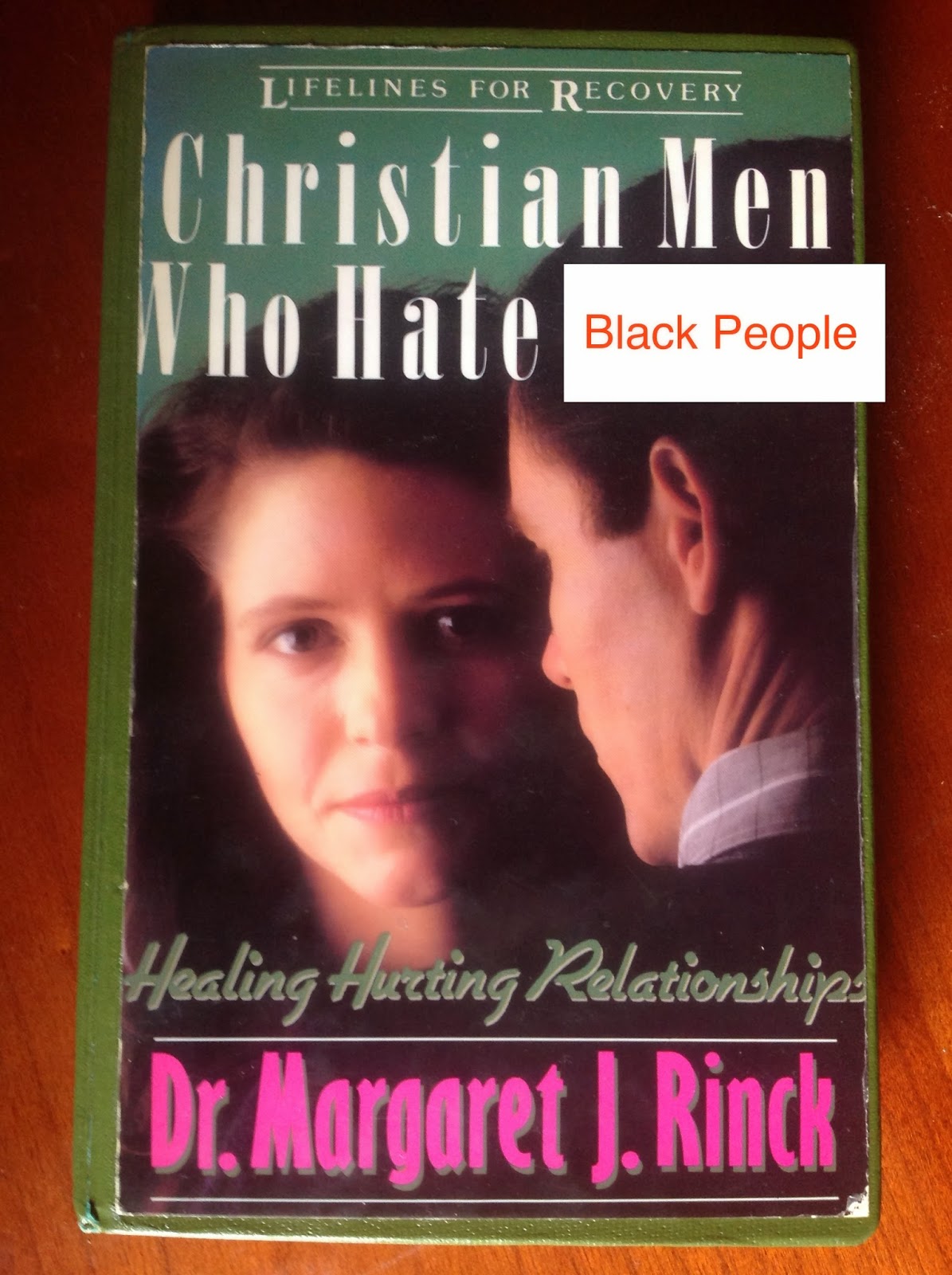
Christian Men Who Hate Women

Despite the cheesy title and vaguely 80s slasher flick cover, the book reads as just as relevant and resonant (Mark Driscoll) now as it did when it was published 24 years ago. From the book:
"Christian men who hate women are in some ways even more dangerous than their non-Christian counterparts. Non-Christian misogynists do not have the additional arsenal of church doctrines, God-talk, and the "sanctioning" of male authority, which comes in a Christian marriage. Their wives are not taught from childhood to 'submit' to men 'no matter what' because it is 'God's will.' Thus Christian relationships based on misogyny are much more complicated due to the theological, cultural, and traditional influences that tend to reinforce the misogynist's prejudice against his wife." (Dr. Margaret J. Rinck, Christian Men Who Hate Women)
This leads to an important question as someone who dates and has dated Christian men: How do you tell if a Christian guy is a misogynist? If he doesn't walk around with a T-shirt that reads 1 Cor. 14:34 or ask you about how much you like to cook and clean on the first date, how will you know?

In addition, should we draw a clear distinction between the dude who makes tasteless and unfunny jokes about women (we all know this dude) from a man who uses or abuses women?

The misogynist is probably always sexist, but is the sexist always a misogynist?

Good question. There is probably no foolproof detection method, but I do know that a guy I dated turned out to be both (it was an unpleasant surprise to say the least).

It started with banal, oft-repeated (by men in general) sexist comments and stereotypes and turned into full-blown hatred, emotional manipulation, and abuse.

So on that fun note, here are some things that might be true of the misogynistic Christian guy:

He believes in rigid, non-negotiable gender roles

I'm not talking having complementarian leanings, I'm talking:

"A woman's primary role is to stay home and take care of the children and the household."

"Women should never hold a leadership role in church."

"If a man isn't the sole provider for his family, then he's not a real man,"

I've definitely met guys who say they would prefer for their wife or future wife to stay at home with the kids--but when confronted with specifics, they actually have no hard-and-fast rules, and that's key. 

He refers to his ex-girlfriend(s) as "a bitch," "crazy," "gold digger," "slut," "overly emotional," etc.

This one seems like common sense, but if your date starts talking about how crazy, deceptive, and destructive his ex was, you might think, "Wow, I'm so much better than his last girlfriend" instead of "I wonder if he's going to talk about me that way too."

Of course, a guy may have been treated very poorly in past relationships. This doesn't excuse talking about another human being with a lack of respect, and there's something about gender-inflected stereotypes and insults that is especially telling--of his character, not hers. 

He uses one tone of voice and type of language around his "bros," and another around you.

He may use sexist humor or the degradation of women and femininity to establish or build rapport with other men. He is one way with his buddies and another way around you.

He often uses hierarchical language to describe himself or other men.

He refers to men as either "alphas" or "betas." He's preoccupied with power differences, particularly between himself and other men his age. He's concerned with appearing "weak" or feminine in front of other guys and looks for their approval in subtle ways.

He's racist, sexist, homophobic and/or speaks about "the Other" with disgust

How does he talk about and treat those he sees as "Other"?  Does he talk about UCLA fans as if they are less than human? Use derogatory language to describe muslims or those of other faiths? Make cruel jokes about those he considers unattractive?

He generally blames other people or things for his problems.

This is a larger character defect obviously not limited to men. But if a man tends to blame others for his actions, failures, mistakes, or shortcomings, this will also apply to his closest relationships. He will be able to justify any abusive words or actions, because they will never, ever be his fault. In fact, they will probably be yours.

He becomes defensive or hurt or attacks you if you confront him about his misogyny or sexism.

Defensiveness is a corollary of the last point. Men who do not take responsibility for their actions are by nature extremely defensive. They have built-in defense mechanisms against anything that might threaten their own views about themselves (as caring, loving, rational, good, etc.).

If you find yourself defending your own actions after confronting his, that is a bad sign. If you let him, he will turn the scrutiny onto you and your perceived faults.

He puts you on a pedestal.
"[T]he greater the idealization, the greater the devaluation when it finally occurs."
- Dr. John Townsend in Hiding From Love
You know what you put on pedestals? Things. Idealization is simply another form of objectification, and has far more to do with his needs than your perfection.

He might treat you like an extremely valuable, fragile glass vase at the beginning of the relationship--striving to meet your every need, handling you with care. Unfortunately, objects are made to be used, and when they no longer serve their (his) purpose, or when they cease to be useful, they are made to be destroyed.

How do you distinguish between the man who treats you with love and respect and the man who idealizes you as an object he can worship?

Is he secure or is he anxious? Does he respect your boundaries? Does he hear what you say or what he wants to hear?

He abuses you physically, mentally, emotionally, or spiritually

I started writing about misogyny, and here I am writing about abuse. I think this because abuse is the end game of misogyny. If you find yourself in a relationship with a misogynistic man, it's only a matter of time before he turns this hatred on you.

Questions:
Is he hurting you?
Is he destroying what you love?
Are you living in fear of "the next time"?
Are you constantly in "fight or flight"?
Are you caught up in a cycle that seems impossible to break?

Please check out more resources about this topic at the end of the post.

I'm not saying that any one of these traits is necessarily indicative of misogyny (with the exception of abuse), but a cluster of them could be a pretty big red flag.

Abusers rarely batter you (physically or verbally) on the first date. In fact, at the beginning of the relationship, an abuser will pour on the love, idealization, empathy, etc., so that when he starts the abuse, you are already "hooked."

The point of this post is simply to point out some of the warning signs of misogyny--so hopefully you can leave before it ever gets to that point.

He eats peanut butter Cap'n Crunch for breakfast

Just kidding about this last one. Peanut butter Cap'n Crunch is my favorite.

Resources:
Christian Men Who Hate Women
Why Does He Do That?
The Verbally Abusive Relationship
Power and Control Wheel
Should I stay or should I go?
The National Domestic Violence Hotline

Friday, December 12, 2014

F*** A Nerd: A Solution to the "Sexodus" Crisis

Ladies, there is a crisis in the land: Cowed and oppressed by the forces of radical feminism, heterosexual men everywhere are checking out of the dating scene and checking into video games and online porn. You might have heard about this crisis, this "Sexodus." It is a terrible, terrible scourge of biblical proportions (the 11th plague) afflicting women everywhere.

But luckily I have come up with a solution:

F*** a nerd.

Find the most pathetic specimen of masculinity possible. The more he loathes himself, the better. The longer he hasn't showered, the more he needs the redemption that only your body can provide. He lives in his mom's basement and watches online porn for 12 hours a day? Perfect.

Throw away those unrealistic and cruel expectations for men manufactured by feminism and romantic comedies. You say you want a man who will treat you with respect, and yet you read "50 Shades of Grey." Twice. Clearly, you don't know what you want.

Plus, you think you're so hot. Well, let me tell you, your expectations are way, way too high. Are you Jennifer Lawrence, Taylor Swift, or Beyonce? No? Then you are fugly at best. However, your female privilege has convinced you that you are all that, two Coach purses, and 54 pairs of shoes. You think you can get a "hot guy" with a job to commit to you. Good luck with that. 

Remember: You can always be replaced with porn and video games. Porn doesn't file false harassment charges. Porn doesn't nag at you to empty the dishwasher or get a job. Porn doesn't say "No" when it means "Yes." Porn doesn't only have sex with assholes. Porn doesn't smile at you one day and put you in the "friend zone" the next. Porn doesn't fight back. Chew on that.

Ladies, if you have sex with a nerd, he might just start to overcome the years of rejection and oppression he has experienced at the hands of our female-dominated society. Sure, he knows he really deserves a supermodel and the six figure job you got just because you are female, but the consolation prize of your subpar body will have to do for now.

Really, it's for the good of humanity, the continuation of the species, and a peaceful resolution to the war on men that's being raged in America.

If we are to end this crisis, drastic measures must be taken. So here's my advice:

Stop trying to get ahead at work. Turn down that promotion. You don't need that promotion. A man needs that promotion.

Stop being good at school [a female-created institution designed to make men feel incompetent and insecure].

Stop volunteering to lead at church. You don't need that leadership position. A man needs that leadership position. If a man stops coming to church, it's your fault for taking the leadership role that was rightfully his.

Stop having expectations for the men you sleep with. It's enough that he condescended to sleep with you in the first place, when he could have been playing Minecraft.

Stop complaining about sexual assault, sexual harassment, and sexism. Men are tired of hearing about it. You are only perpetuating the feminist myth that all men are rapists and pigs. Men will assume that asking you on a date will get them charged with assault.

Stop sending mixed messages. Either you want a real man who forcibly takes what he wants or you want a passive nice guy who treats you as an equal but never makes a move. You can't have both.

Women: the choice is simple. If you don't "lean back" and spread your legs, unemployed men drowning in self-pity who have given up on any semblance of personal hygiene are going to refuse to have sex with you.

Do you want to die single and alone? I didn't think so. Get out there, and start f***** as many undesirable and unattractive men as you possibly can. If you're lucky, one of them might even agree to marry you.

But don't count on it.


Inspirations:
Lysistrata by Eurpides
Matt Walsh
Article about the "Sexodus"

Monday, December 1, 2014

Undateable: Why Single Christian Guys Are All Dented Cans - Introduction

I love the miscellaneous sale section at Ralphs. Tucked between the dairy section and the packaged meats you can find nine dollar bottles of wine, congealed donuts, leftover Halloween decorations, six-day-old apple pies, Duck Dynasty costume castoffs, cartons of pedialyte, bruised apples, liver-spotted bananas, and Barbie bandaids.

Way, way in the back, hidden behind a few dubious boxes of laxative tea and 100 count bottles of aspirin, it sits.

Our friend, the dented can.

Back when I worked full-time at a book warehouse, I used to read a lot of books (more like skim, but who's judging). One of those books was a chick lit novel called The Big Love written by Sarah Dunn.

The twist in this particular novel is that the heroine was a lapsed evangelical Christian. And there was this one passage that stuck out to me, which I've excerpted at length below, that made me go Yes Yes I SAID YES:
My happy place
Photo by labullets.blogspot.com
I should have known about Gil, of course. I should have known the way you know about a dented can. But this is the thing: everyone has been warned about dented cans, but surely not every dented can is bad, or they wouldn’t be allowed to sell them, right? Someone’s buying those dented cans. Someone’s taking them home and opening them up and examining the contents and then making a bet about whether or not the stuff inside is safe to eat. And let me tell you, when you’re twenty-five, and a virgin, and you refuse to date anybody but a Christian—and not just any Christian but a certain kind of Christian—your options are all dented cans. When Gil and I finally broke up, I took another look around the church basement, and I had the closest thing I’ve ever had to an actual vision. There sat Brian Berryman. Single. Thirty-two. An attorney. Crown prince of the church basement. So morally upright he didn’t believe in dating; he believed in praying. He’d been praying for a wife since he was sixteen. He’d drawn up a list of all the qualities he wanted her to possess, a list which he was continually revising, and then praying about, and then revising some more, and then informally circulating among the single women at the church. A woman of pure heart, the list would go. A gentle and quiet spirit. A submissive nature. Is this what you want in a husband? I heard a voice saying. Well, not an actual voice, but it was as clear as day. I realized that if I kept searching for husbands in church basements I was going to end up with a seriously dented can. [from The Big Love by Sarah Dunn, emphasis mine]
"So, what, Ms. Blogger, are you saying that all single Christian men are dented cans?"

Yes. Hell, I've dated a few of them.

No, but it sure feels like it sometimes, as if I'm walking by the sale section, scoping out the goods and thinking, "Oh please, Lord. Not that one."

When it comes to dating within Christian evangelical culture, it often feels as if you're screwed if you do, and screwed if you don't (or not screwed either way, now that I think about it).

That's the honesty part of this post--the hopelessness part. But this series (Yes! A series!) is not about hopelessness--it's about those qualities in single Christian guys that make them undateable.

I'm well aware that we are all dented cans. But perhaps a distinction can be made between the can of diced tomatoes sporting a few delightful and adorable indentations from being dropped on its head a few times and the can of sliced yellow peaches in a light syrup that gives you a fatal case of botulism.

Join us next time for a lighthearted take on:

Undateable: Why Single Christian Guys Are All Dented Cans - The Misogynist
Undateable: Why Single Christian Guys Are All Dented Cans - The Coward
Undateable: Why Single Christian Guys Are All Dented Cans - The Racist
Undateable: Why Single Christian Guys Are All Dented Cans - The Myth of Persistence 
Undateable: Why Single Christian Guys Are All Dented Cans - Entitlement